Grenoble Population and Area (Isère)
Largest city in France 2026: up-to-date figures for Grenoble (Isère)
Grenoble: Population and Area
With 158,303 inhabitants (INSEE total population in force on January 1, 2026), Grenoble is the 19th most populous town in France in 2026 and the most populous in the Isère department, out of 512 communes. It covers 18 km² (9,352nd largest area in France, 111th largest in the department), with a population density of 8,732 inhabitants per km², or 80 times the national average (110 inhabitants/km²), which ranks it 56th in France for density.
Grenoble is located in the Isère department (38), in the Auvergne-Rhône-Alpes region (formerly Rhône-Alpes), where it ranks 4th by population out of 4,025 communes. It is the most populous town in the Isère department, which is home to 1,324,225 people over 7,431 km².
See the full ranking of communes in the Isère department and the regional ranking: largest city in Auvergne-Rhône-Alpes.
Towns of similar size in the Isère department: Saint-Martin-d'Hères (pop. 37,921), Échirolles (pop. 37,710), Vienne (pop. 32,216).
Sources: INSEE, official population figures in force on January 1, 2026 (total population); areas: IGN / Observatoire des territoires; INSEE code 38185. Rankings are calculated across the 34,858 communes of metropolitan and overseas France in our database.
Grenoble, the largest city in the Alps
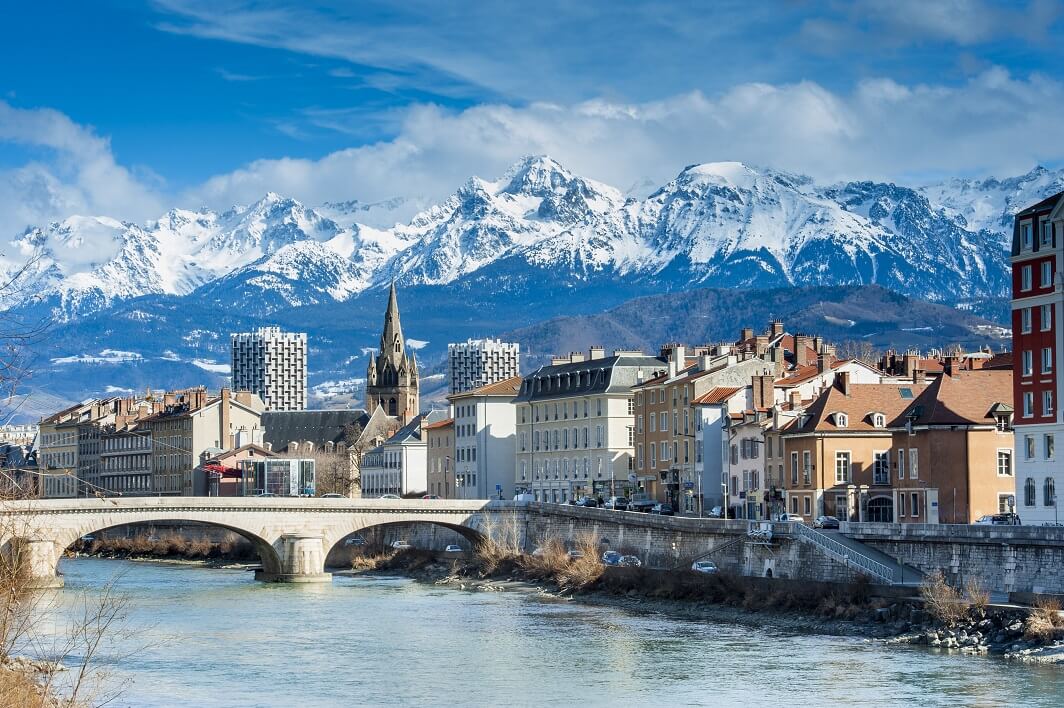
No other Alpine city, not Innsbruck, not Bolzano, matches the size of the Grenoble urban area, which is why the capital of the Isère department is nicknamed the capital of the Alps. Set on the plain where the Isère and the Drac rivers meet, the city is hemmed in by three mountain ranges, the Chartreuse, the Vercors and Belledonne, which strictly limit its expansion.
A narrow territory for a dense population
Because of this terrain, the commune of Grenoble is small for its rank and densely populated: the urban area has grown into the neighboring towns of the basin, such as Échirolles, Saint-Martin-d'Hères, Fontaine and Meylan. Its population surged with "white coal" (hydropower) in the late 19th century, then with the 1968 Winter Olympics and the rise of a European science hub, with its laboratories, synchrotron and university, which today makes Grenoble one of the most student-oriented and technology-driven cities in France.