Besançon Population and Area (Doubs)
Largest city in France 2026: up-to-date figures for Besançon (Doubs)
Besançon: Population and Area
With 121,627 inhabitants (INSEE total population in force on January 1, 2026), Besançon is the 33rd most populous town in France in 2026 and the most populous in the Doubs department, out of 563 communes. It covers 65 km² (647th largest area in France, largest in the department), with a population density of 1,870 inhabitants per km², or 17 times the national average (110 inhabitants/km²), which ranks it 485th in France for density.
Besançon is located in the Doubs department (25), in the Bourgogne-Franche-Comté region (formerly Franche-Comté), where it ranks 2nd by population out of 3,685 communes. It is the most populous town in the Doubs department, which is home to 560,477 people over 5,223 km².
See the full ranking of communes in the Doubs department and the regional ranking: largest city in Bourgogne-Franche-Comté.
Towns of similar size in the Doubs department: Montbéliard (pop. 25,159), Pontarlier (pop. 18,956), Audincourt (pop. 14,303).
Sources: INSEE, official population figures in force on January 1, 2026 (total population); areas: IGN / Observatoire des territoires; INSEE code 25056. Rankings are calculated across the 34,858 communes of metropolitan and overseas France in our database.
Besançon, historic capital of Franche-Comté
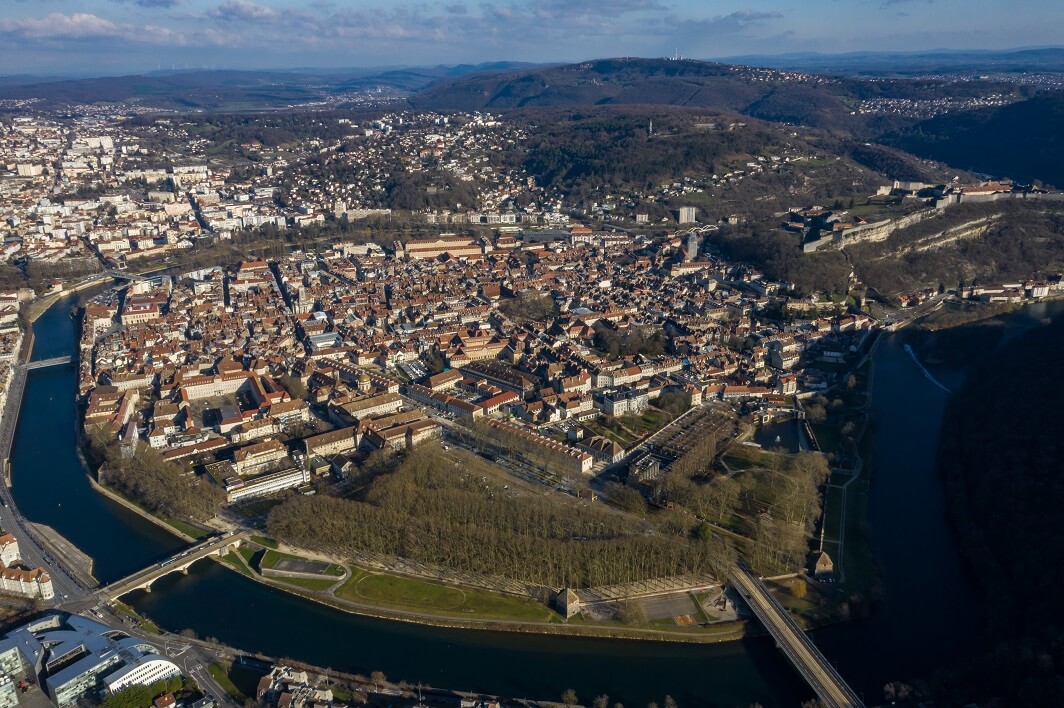
Prefecture of the Doubs and seat of the regional council of Bourgogne-Franche-Comté, Besançon is the major city of the eastern part of the region, less than fifty kilometers from Switzerland. Its exceptional site, an almost closed loop of the Doubs River overlooked by Vauban's citadel, a UNESCO World Heritage site, made it a major stronghold and a provincial capital.
A large city with moderate density
France's watchmaking capital in the 19th century, Besançon has reinvented itself in microtechnology and biomedicine. Its wooded hills, its parks and the loop of the Doubs take up a large part of the town's territory, which has earned it the title of France's greenest city and a density far lower than that of Dijon, its neighbor and regional rival. The population, stable for some thirty years, is sustained by a university that welcomes thousands of students every year, many of them international students who come to learn French.